Showing posts with label Not-so-random questions. Show all posts
6

The Pep Talk - Part 1

Posted by JSYL on Wednesday, May 20, 2009 in ,
I met him outside a train station on a Friday night. Almost a year had passed since our last run-in, outside uni production suites, in between ABC and SBS cadetship applications. A brief hug and an exchange of knowing smiles proved that the bonds of Journalism school remained intact.

"Where to, coffee or a[n alcoholic] drink?" he asked.
"Up to you," I said, instinctively accommodating.
He cocked his head to the side, treading the waters of my unusually courteous behaviour with some trepidation: "Coffee then?" he suggested.
He was right to hesitate. It's Friday.The sudden realisation somersaulted it's way through my oesophagus, landing in my stomach with a dull thud.
"We're journalists now. We need to drink," I said, firmly steering his elbow around the shiny puddles that littered the busy road before us, and into the comfort of the nearest pub.

Over a few G+Ts we exchanged war stories of our first 'journalism' gigs, both now fully fledged members of the Business-to-Business industry, both trying to justify our roles at our respective companies by referring to ourselves and each other as if we belonged to some strange breed of that elusive creature we call 'journalism'.

Y'see, we both graduated under the flawed if not false impression that unless we were employed at a prominent media organisation (which, given the small size of the Australian media industry reduces the pool of potential employers to the Sydney Morning Herald, the Australian, the ABC and SBS), or were at the very least reporting news every day, we could not consider ourselves real journalists, regardless of how much we'd like to.

As the night wore on, the conversation gave way to bitching and moaning about how hard it all was. We had known it would be 'hard' but not 'this hard' to find our dream jobs. (This, just shy of three months out of university.) At one point, my friend drew his line in the sand, "I'm applying for ABC and SBS again this year. And if it doesn't work out, I'll start thinking about jobs in DFAT (the Department of Foreign Affairs and Trade)."

It could just have been the two G+Ts, or perhaps the Cadillac Cosmopolitan- which, by the way, you should ALL try. It has a raw egg in it and EVERYTHING...very fancy - but I was truly stunned at this revelation. He may as well have told me that yes, he, Darth Vader, was indeed my father after all.

For, to me, to go from Journalist to Politician Spin Doctor would be crossing over to the Dark Side. It's not that journalists and politicians are necessarily opposed to one another (although that is debatable, feel free to challenge this in the comments below) but I would've thought at least part of the appeal of the former profession was the ability to "keep the bastards honest" (ironically) in blunt terms, or rather to be the Fourth Estate.

And more than that, to study a particular discipline for years, and presumably, to follow the careers of journalists you aspire to become more like for many more years, seems like too big a commitment to throw away after one year in the school of not-so-hard knocks.

He assured me that DFAT was his last resort but reasoned that there was only so much one could take in this quasi-journalistic environment. One example he gave was this: one of his stories had, though later nominated for an award, been removed from its website a day after he had posted it because it conflicted with a number of key advertising sponsors. Despite the fact that anything that takes up Internet space for a day can potentially reach millions more than news printed in a trade magazine ever could, It begs the zen-like question:

If a groundbreaking news story has no audience, is it still news?


Over to you, dear readers.

Tune in for the actual pep talk next post.

--

*Update*

This question turns the overused (and kind of absurd) argument - 'kids these days' have it easy when it comes to the media industry because we can 'publish ourselves' on the Internet in one fell click - on its head. Zillions of hits do not maketh Perez Hilton a 'celebrity journalist'. But the blogger vs. citizen journalist debate would not even exist without the huge readership that website attracts on a daily basis. Does a journalist's value therefore turn on the size of its audience?


[Photo: http://3.bp.blogspot.com/]

|
1

Russell Crowe: Media friend, foe, or ho?

Posted by JSYL on Thursday, April 16, 2009 in

Did anyone else find it kind of amusing that Russell Crowe, who only three years ago was responsible for this media mess, which led to the suicidal death of Jack Marx's credibility and career, played a 'journalist' in the new film 'State of Play'?

Reuters did, though for other, more technical reasons.


(Source: http://2.bp.blogspot.com)

|
4

Journalism school a waste of money?

Posted by JSYL on Sunday, April 12, 2009 in ,

In about a month I will finally graduate from 5 years at university.

Yet tonight, for the first time, I started questioning what it might really be worth.

My Journalism degree alone cost my parents a whopping $AUD 7518.60 (not including student union fees before Voluntary Student Unionism came in force, and textbooks, which I paid for myself, or the huge cost of letting me go on exchange in 2008. I shudder to think what the other degree cost them). At the time of writing, that's the equivalent of £3 688.97, USD 5,402.86 and €4,106.45.

...Pause for gaping mouths to close...

It's an age-old debate: can 'Journalism' ever be truly 'taught'?

Every Journalism student has come across at least one successful journalist from the old school o' hard knocks, coffee mug in hand and notepad at the ready. He (it's usually a 'he') poo-poohs the notion of 'Journalism school' (always spoken with a wry smile and a sarcastic tone), explaining that he got to where he was by clinging to his street smarts, raw talent and sheer luck.

And for every one of those there is another suited up, slicked back journo with 20 years of contacts who's rapid-fire thought pattern betrays his smooth, laid back demeanour that comes only from the reassurance that the combination of all that education and experience and a full-time job can bring.

Given the current climate (That must be the world's most over-used phrase of the century) I'm not the only one thinking about this. The debate is finding new relevance now as media jobs decline, and the future of Journalism becomes more uncertain. If the truly brilliant are struggling, where does that leave the rest of us? Indeed, despite burgeoning enrolment rates at Journalism schools the world over, only in 2016 will reporter positions increase. Great. Only 7 years to go.

I cannot deny the personal value of the university experience. I met some of my best friends and learned some of my hardest emotional lessons to date while there. Most (sadly not all) of us have by now, through university, acquired a bulk of the social and life skills needed to get us through to adulthood and the Real World.

And let's face it, these days going to university is so commonplace it's almost rare to find someone without at least one degree upon entering the workforce.

But after all that, though better off personally and to some extent professionally for the experience, I have to wonder if maybe, I might've fallen into Journalism even without it, as so many of the best seem to have done, and left my parents $7518.60 richer, to make up in some small way for the recent death of half of their superannuation fund.

|
0

WWJD?

Posted by JSYL on Saturday, April 11, 2009 in

I'm about to start getting ready to go to Mass on Easter Sunday. But I'm also thinking about not going in protest of this. And the church wonders why congregation numbers are dwindling. The Vatican needs to start revising the party line.

|
3

The best of times for journalists?

Posted by JSYL on Wednesday, April 08, 2009 in ,

Many grads can relate to having done all the 'right things' to get our foot in the door to Oz otherwise known as the media industry. With the early days of (at times) dull work experience, (more promising) internships, free bylines, and getting our first important media contacts through brilliant initiative and sheer luck long behind us, we were probably of those well placed to survive the competitive fight for limited entry level positions in media.

But since the global economy decided to explode, journalism's become an even harder gig to pull. We too have been left clinging desperately to the frame of that same door, kicking and screaming so it doesn't shut on us completely.

BBC journo Andrew Neil, in 2006, raised a similar argument to News Limited chairman John Hartigan's in 2007: that the digital age presents journalists with greater challenges but also massive opportunities that must be embraced in order to move forward. Though written from the comfort of a time when being made redundant was a condition only suffered by people close to retirement, rather than being a rite of passage for 20-somethings that might have otherwise been on their way to lifelong careers, I think some of his words still ring true today.

While I use the words 'journalist' and 'journalism' really loosely throughout this blog (the endless interpretations of what it means to be truly a part of that profession are so far-reaching they've made up entire semesters worth of discussion that are for another blog, another day), I come from a school of Journalism that has always drummed into its students the notion that 'journalism' and 'PR' always clash.

Yet as I learn more than ever before about the media in the workforce itself, it seems as if we all have to 'sell' ourselves, rather than 'prove' ourselves to be worth a position, now, perhaps more than ever before. Neil confirmed my fear:

"The editors of the future who want to entice the best and the brightest will have to cater for journalists who are brands in their own right and who develop their brands across various platforms, not always for you exclusively.

"The journalists of tomorrow will write for newspapers, contribute to magazines and podcasts, work for TV production companies and write their own blogs, because you wouldn't give them a column then they will sell the blog back to you at an inflated price"


Then again, maybe, as Neil suggests, this change will be to our benefit as it gives us greater independence from newspaper barons or media moguls, and therefore, better quality journalism:
"The days when journalists were wholly owned subsidiaries of a single editor are coming to an end, and those who try to run journalists that way will end up employing dummies and the best and the brightest will have gone elsewhere."

I guess technology's just made it that much harder, and easier at the same time to get in the door. Here's to hoping we can do it without (completely) losing our integrity in the process.

|
3

Logical Suicide Bombing?

Posted by JSYL on Tuesday, September 02, 2008 in
…modern suicide terrorism is analogous to instances of international coercion. For states, air power and economic sanctions are often the preferred coercive tools…For terrorist groups, suicide attacks are becoming the coercive instrument of choice.”

Robert A. Pape*, The Strategic Logic of Suicide Terrorism, The American Political Science Review, Vol. 97, No. 3 (Aug., 2003), at p. 344

*(Professor of Political Science at the University of Chicago specializing in international security affairs who's very well respected as an authority in his field, and a critic of the war on Iraq and more generally on America's international strategies following September 11).

Please discuss (educated opinions or sensitive questions only).

|
6

"Education Revolution"?

Posted by JSYL on Thursday, August 28, 2008 in ,
Do you think public education can be treated like a free market?

Discuss.

---

Update: It's quite clear I study arts, and not commerce. James and Wikipedia have made me realise I misused the term 'free market'. What I meant to ask (though it's far less catchy than my original question) was this: Can the underlying philosophy of laissez faire- that is, that the order of things be determined by the natural forces of supply and demand- be applied to the public education system?                      

The reason I ask is because one of the Australian government's most recent steps towards a self-proclaimed 'education revolution' proposes that schools' performance be ranked across the board, and that this information be available to parents everywhere. Consistently badly performing schools may be shut down, merged with other schools, or have their principals sacked.

The argument for the policy is that public education is the government's economic investment into 'human capital'. It would render teachers and principals alike accountable for their schools' performance, and give them incentives to do well, placing schools in a competitive market environment. It has however come up against heavy criticism, with teachers' unions arguing that, unlike corporations, there is no fair way to rate how 'well' schools perform, and that students would only be disadvantaged by any funding cuts or dramatic changes to their school's structure that would take place as a direct result of such a rating.

With that in mind- discuss!

[Photo: CBS Local]

|
0

The ‘Imperfect’ Obama Union*

Posted by JSYL on Thursday, March 27, 2008 in ,
By Jane Lee

In a recent speech, Barack Obama described his presidential candidacy as ‘imperfect’. The rapid momentum generated by his campaign in the current U.S. elections over the past year is best illustrated by countless variations of the same photograph splashed across newspapers and magazines around the world. It is of 46-year-old Obama, beaming and waving to hundreds of thousands of Americans at campaign rallies across the country, often beside one of the many celebrities who have publicly expressed their support for him- a long list which includes the likes of Oprah Winfrey, George Clooney, Matt Damon, Halle Berry and Sharon Stone.

Obama has had a relatively short political career compared to his opponents, fellow Democrat Hilary Clinton and Republican John McCain. Yet with a lead of 143 elected delegates over Clinton in the ongoing primary elections, he is a clear favourite in the race to become the next president of the United States of America.

Obama’s personal background is well documented. His mother was born in Kansas, his father, a Harvard graduate, in Kenya. Raised partly by his maternal grandparents in Hawaii, he also lived in Indonesia with his mother during his formative years and was the first African American president of the Harvard law review. Obama worked as a constitutional lawyer and a legal academic for a few years before being elected Illinois’ state senator in 2004. One of his most notable achievements while in public office includes creating a law that made the allocation of resources from state taxes accessible online.

The timing of Obama’s grand entrance into federal politics was ideal. As his presidential campaign arrived on the heels of the past mistakes of an increasingly unpopular Bush administration, his career has yet to be tarnished by sexual scandals or senatorial misconduct. “Mr Obama is the only major candidate who has been able to ride out his campaign as the guy who came from almost nowhere, thus unencumbered by the need to defend any old policies or past decisions,” wrote Danny Ayalon in the Jerusalem Post earlier this year.

If elected, he would be the first ever African American president, and as such, political commentators around the world argue that Obama’s candidacy creates a beacon of hope for (as his campaign slogan promises) ‘a change we can believe in’, particularly in response to international issues such as terrorism and climate change that became prominent during George W. Bush’s presidency.

“It is about identity: what face- literally- America presents to the world. The next president needs to bring this country out of its unusual gloom. To prove that America can be intelligent and thoughtful and compassionate. In short, to make America truly powerful again,” said Camilla Cavendish in Times Online.

Obama’s reputation as a composed and diplomatic orator indeed portrays the antithesis of George W. Bush, whose presidency will forever be characterised by September 11, the U.S. invasion of Afghanistan and Iraq, and the culture of aggressive foreign policies that ensued. Where Bush’s reign was fuelled by America’s formidable might in the face of global threat, Obama claims he will champion the revival of a peaceful, open dialogue between world leaders.

“The United States is trapped by the Bush-Cheney approach to diplomacy that refuses to talk to leaders we don’t like. Not talking doesn’t make us look tough- it makes us look arrogant, it denies us opportunities to make progress, and it makes it harder for America to rally international support for our leadership,” says Obama’s Blueprint for Change in America. “On challenges ranging from terrorism to disease, nuclear weapons to climate change, we cannot make progress unless we can draw on strong international support.”

Many critics still view Obama as a two-dimensional poster boy for multiculturalism with limited substance as a serious candidate. “Obama has moulded himself into the male Oprah Winfrey, the crown prince of niceness, bravely denouncing divisiveness, condemning controversy, eulogising unity, and retelling his feel-good life story,” said Steve Sailer in the American Conservative.

Obama’s campaign promotes his bi-racial heritage as indisputable proof that he will better understand the cultural needs of both sides of the black-white racial divide still plaguing America today because it allows him reach out to a wider range of people on such issues with a great measure of credibility. His most recent speech, “A more perfect union”, was no exception.

Held in Philadelphia last week, it was made in response to footage that showed Obama’s pastor of 20 years, Jeremiah Wright, making ‘anti-American’ remarks. Wright had been filmed on various instances telling his congregation that they should sing “God damn America”, that the American government had created the AIDS virus as a way of killing African people, and essentially deserved the September 11 attacks as punishment for its past misdeeds against ethnic minorities.

The controversy that emerged marked the first real test to Obama’s campaign. It prompted the senator to seriously address the issue of race relations for the first time. Obama used his personal experiences with a mixed cultural background to encourage reconciliation. He explained the complex reasons for the bitterness belonging to both black and white people in America, rather than outrightly condemning Wright’s comments.

“I can no more disown him [Wright] than I can my white grandmother - a woman who helped raise me…a woman who loves me as much as she loves anything in this world, but a woman who once confessed her fear of black men who passed by her on the street, and who on more than one occasion has uttered racial or ethnic stereotypes that made me cringe,” he said.

Obama argued America should, in line with his own campaign, move beyond racial, religious and conservative-liberal divides that have coloured the country’s political landscape for centuries, to focus on resolutions to national problems.

“He [Obama]…demonstrated that he can use his formidable rhetorical powers to address difficult subjects rather than simply to rev up a sympathetic crowd,” wrote The Economist.

The speech opened up the floodgates for debate once considered taboo to enter in American society. “Finally we can talk about race without being afraid we are offending others,” said daytime talk-show The View co-host, Barbara Walters.

But Obama’s candidacy represents much more than a conscious or unconscious catalyst for social change. Gravely underestimated are the massive implications his uniquely bipartisan worldview would have for the future of international relations and global diplomacy.

Obama’s greatest responsibilities as President would be twofold; the first would be to determine the fate of America’s relationship with other world leaders. Cancelling a European tour earlier this year to focus on presidential contests in Iowa and New Hampshire, he has not yet met UK Prime Minister, Gordon Brown.

“Obama talks the language of free trade as eloquently as Brown, but walks the walk along the well-trodden path laid out for him by the trade unions…of the two, Obama's protectionism is the least strident. So Brown might be comfortable with him,” speculated the Hudson Institute’s Irwin Stelzer in the Telegraph.

“But it seems reasonable to guess that Brown, so policy-heavy and charisma-light, more Clinton than Obama, harbours suspicions of a young, handsome, charismatic politician long on charm and elevating rhetoric, but short on policy details,” he said.

Samantha Power, a member of Obama’s foreign policy team, told the Telegraph earlier this year that she believes his presidency would go far in reducing the anti-American sentiment that exists in Britain.

“Any British leader is harmed domestically in terms of public standing by association with President Bush, the reverse will happen with President Obama. Obama reminds people of the better angels of America,” she said.

Obama may have already established a good relationship with French President, Nicolas Sarkozy. When he was France’s interior minister, Sarkozy met Obama during his visit to Washington D.C in 2006, along with only two other American politicians- President Bush and John McCain.

In early 2007, Obama praised Sarkozy in an interview with Agence France-Presse, "He [Sarkozy] is a man of enormous energy and enormous talent. I was impressed with his willingness to look at the issues that France faces in a new ways, not bound by tradition and dogmas.”

Obama would secondlly need to decide what action the U.S. will take in response to international conflicts in countries such as Iran and Israel-Palestine, and human rights abuse in countries such as Sudan, which his predecessors have been unsuccessful in resolving.

His campaign spells out clear goals for the future- withdrawing American troops from Iraq within 16 months, assisting Iraqi refugees, reducing global poverty, ridding the world of nuclear weapons, and establishing separate and harmonious Israeli and Palestinian states. But Obama is still vague on how he will go about implementing strategies to achieve them.

“As far as Israel is concerned, Obama has yet to suggest specific measures he would enact regarding the Jewish State's Qualitative Military Edge that allows us to defend ourselves against our current and future enemies,” said former Israeli ambassador to the United States, Nefesh B'Nefesh, in the Jerusalem Post.

Obama proudly claims he is neither left nor right wing, but a man for the people. “I don’t want to pit Red America against Blue America, I want to be the President of the United States of America,” he said in Blueprint.

This poses a frightening prospect to interest groups seeking a more definitive stance, or at least guidance, on the new direction the world will take in the face of ongoing international crises.

“Given the increasingly tense security environment Israel is confronting on all sides, now is not the time for American leaders to shy away from such fundamental questions. The four years ahead are far too critical for global security to place the presidency of the United States in the hands of a leader whose campaign is leaving us with more questions than answers,” B’Nefesh said.

If elected, Obama is likely to take a softer, more cautious approach to international issues, using diplomacy, rather than military action, as a first resort where possible. On the threat Iran poses, Obama’s Blueprint for Change says his government would provide economic incentives to curb it’s nuclear program and support of terrorism, “Obama believes we have not exhausted our non-military options in confronting this threat; in many ways, we have yet to try them.”

The U.S. would then pose less of an immediate physical threat to a global community that have come to expect it from a government that single-handedly redefined the international legal phrase “pre-emptory attack”.

Obama’s domestic policies, though not as well publicised, are much more clearly defined in areas such as health care and education. Obama also outlines in his Blueprint for Change a number of laws aimed at increasing the transparency of presidential records and the accountability of lobbyists to the public. Though far less glamorous than their international counterparts, such policies still represent significant changes in American governance.

Even if he does not win the presidential nomination, Obama’s ‘imperfect’ candidacy has already changed the face of American politics. In Philadelphia, he admitted as much, “As so many generations have come to realise…that is where the perfection begins.”


*My first article for my International Journalism module. It was due the day I got back from my snowboarding long weekend. Considering I wrote this every spare second I got between snowboarding, hopping on and off a bus, a plane and two other trains on the way home, I think its pretty damn decent.

|
0

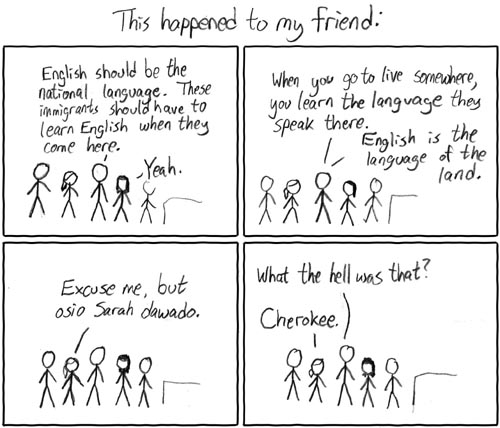
Future of Australian Citizenship?

Posted by JSYL on Thursday, November 16, 2006 in


- Randall Munroe, http://xkcd.org/c84.html


Increasingly relevant and rings true to my views at present...the irony that is, not the bigotry if that wasn't clear from the outset. Thoughts?

|
0

Clarification Post.

Posted by JSYL on Saturday, June 17, 2006 in ,
Here you go, Tim.
In black and white? In Australia, we have an ageing population with a trend towards couples having fewer children. The solution thus far has, as I said before, been predicated on the assumption that the onus is on women, being physically able to give birth, to have more babies.

Rather than looking beyond the physical aspect of giving birth, you Tim, (yes I do mean you Tim Tjun Wong who commented below =p) and Costello (sorry to lump you in the same category as our soon-to-be-God-save-us-all new PM) have lightheartedly, insensitively and offensively overlooked a number of things that influence a woman's decision to have babies.

Herein lies the double standard:
Men say: women have a uterus, so why wouldn't they want to have more kids for the good of the nation?
Other men say: That woman has millions of kids by different fathers, she is a slut.

Men say: go have kids! don't be a selfish bitch!
Men also say: but i'll be damned if I'll pay any money to support those kids! (i.e. fathers who won't pay child support)

Men say: go have kids- its easy to do, you have a high-paying job that can financially support them.
Men also say: but if you don't give up that career, you are a money hungry ice-queen. if you choose to work and be a mother, we're not going to let you get much further than where you are, and we won't provide child care for the kid- you're on your own there.

These i realise, are vast generalisations, but they show you (i hope) quite clearly the fact that while it is a woman's duty to pop them out, once they're "out", it is not a man's duty to do all the things neccessary to help that woman and those children survive in the real world of supposedly equal rights. I argue therefore, that women are both encouraged to have kids, and discouraged from doing so realistically because of all the difficulties they would face if they were to have children.

So to answer your question- I'm not just mad, I'm morally against comments that dismiss women as simply baby factories and milk pumps. I'm not mad at all men, I'm not even mad at the men who make such comments. I'm against the general attitude that women hold both the cause and solution to Australia's population crisis in their uterus-es (uterii??), and that men play absolutely no part in the scheme of things..

I think that many people (note- both MEN AND WOMEN) often forget that it takes 2 people to make a baby, and many many more to support and love that baby. It should not be dismissed as an easy choice, nor an easy solution to a much more complex issue.

|
1

Australia's Population Crisis.

Posted by JSYL on Wednesday, June 14, 2006 in
The director of the Centre for Population and Urban Research, Bob Birrell has shed a little light on our ageing population, saying in The Australian's What Women Want, 15 June, 2006 by Elizabeth Gosch and Patricia Karvelas:

"There is a marriage gap for women in their late 20s and early 30s who are unpartnered because there are more of them with degrees than there are men with degrees, and this is going to be a continuing issue because currently 55 percent of the people who commence degrees are women and 45 percent are men..."

"...Women have traditionally looked upwards in social status terms, but that's simply not going to work any more because just in educational terms there are more achievers among women than there are among men, so it does mean that many of these women will have to adjust."


How interesting. Not once in this article did I see it suggested that perhaps the onus lies on 'under-achieving' men. Maybe if men were encouraged to pursue academic success and therefore ensure higher starting salaries in white collar positions, there'd be more couples, more sex, and more babies.

Sound absurd?

By now you think I'm a Feminist Nazi with no arguments of any logic or substance. But I ask you, is my policy equally or more retarded than Costello's supposedly lighthearted comments not so long ago, that:

"If you can have children it's a good thing to do . . . one for your husband, one for your wife, one for your country...You go home and do your patriotic duty for your country."
(See: Fiery response to Costello, Townsville Bulletin, 13 May 2004, Tony Raggatt)

Let's add Tim's argument into the mix; namely that (paraphrased/summarised for the purposes of this rant):

'Women are genetically predisposed to waking up at three in the morning to breastfeed, it comes hand in hand with their ability to give birth...which is why women don't need to sleep as much as men generally.'

Does it then flow on, by this logic, that men have a blue-collar non-academic, non-willingness to pursue tertiary education gene, that somehow links to their predisposition to lazy-motherfucker-itis?

And if that is the case, then we indeed have a real moral conundrum on our hands, people.

And before you completely tune off, I am, albeit poorly, struggling to make a point: this whole 'populate Australia' debate has always been predicated on the assumption that its the responsibility of women to up the ante and slut it up, simply because if God gave them the uterus to do so, why wouldn't women want to give birth?

Rather shouldn't we (meaning the men making these ludicrous remarks) look perhaps at elements other than the physical push involved in having a baby? Emotional and financial support and security, social acceptance, secure home, a father figure, a husband, sperm.

Its not just a female problem. Women with 5 kids by 4 different fathers are seen as sluts sponging off the dole. Educated women in their 30s who are single and have no children from former marriages etc are viewed as frigid career hungry ice queens. Women who are married but choose not to have children are seen as counter evolutionary and not 'real women'.

All social stigmas, all created by men who at the same time, want women to have MORE children.

Never once thinking that men who don't make child support payments, forcing single mothers to rely on the Government for money, who don't strive for the top rung of the corporate ladder or even just financial stability and independence, or conversely are the men keeping that glass celing in place which DISCOURAGES women from having children, or the men who have a low sperm count and as a result can't give their WIVES and their country children...are the true causes of fertility decline.

Perhaps if both men and women were seen as equal or somewhat equal players in the procreation policy, a less sexist and more realistic solution may be found after all.

Overly optimistic? Perhaps.
Utterly impossible? Not quite.

|
Related Posts with Thumbnails